
It has built confidence in the possibility of change; now reality has to catch up with the image and the expectation, says T N Ninan.

He said both countries are opening new areas of cooperation in the energy sector, telecommunications and science and technology and they have set up funds to facilitate investment in high technologies.

India and China have not ruled out a Modi-Xi meeting during the summit.

The keynote address will be given by United States President Donald Trump

Modi will have a number of high-profile multilateral and bilateral meetings with global leaders including United States Vice President Mike Pence and Singapore premier Lee Hsein Loong.

Prime Minister Narendra Modi made a strong pitch for deeper ties in key areas of counter-terrorism, climate change and UN reforms.

The study paper by Melbourne-based think-tank Australia India Institute titled 'The G20: Challenges and opportunities Ahead', said following Prime Minister Narendra Modi's visit to the US and his talks with US President Barack Obama, India may finally sign the agreement.

India shifted gears in rejuvenating strategic ties with its major partners like the US and Russia and focused on drumming up global support for its distinct strategy in the Indo-Pacific to check Beijing's increasing muscle-flexing in the region.

The annual talk-fest of rich and powerful from across the world in snow-laden Alpine resort town of Davos will be attended by nearly 40 heads of government among more than 2,500 global leaders from over 100 countries.

In what is seen as the first sign of China's exasperation over Russia's Ukraine war, Chinese President Xi Jinping on Thursday raised 'questions and concerns' over the conflict in his meeting in Samarkand with Russian President Vladimir Putin who thanked Beijing for its 'balanced position' on the crisis.

She lamented that Africa despite being the largest continent in terms of number of the countries and India, which has has one-sixth of the world's population, still don't have permanent membership of the UNSC.

In 1930, John Maynard Keynes predicted that by 2030 technology would be so advanced that three hours of work per day would suffice. Has AI brought about the transformation that Keynes predicted, asks Atanu Biswas.

Trade between Australia and India stands at around $15 billion a year, or just a tenth of that between Australia and China.

During the meeting on the sidelines of the 11th BRICS Summit on Wednesday, prime minister Modi said there was a "new direction and new energy" in bilateral ties after the two leaders' second informal summit in Chennai.

Blinken will also attend a meeting of the foreign ministers of the Quad grouping and will hold bilateral talks with his Indian counterpart S Jaishankar in Delhi.

The Chinese Communist Party's all important 19th Party Congress is just months away, and President Xi Jinping finds himself confronting unlikely challenges to his pre-eminent position, says former RA&W officer and China watcher Jayadeva Ranade.

Amid imminent phasing out of the fiscal stimulus by US Federal Reserve, Prime Minister Manmohan Singh on Wednesday called for an "orderly exit" from unconventional monetary policies being pursued by the developed world for the last few years to avoid damaging growth prospects of the developing world.

With Modi's international image seriously damaged -- perhaps, irrecoverably -- and Indian foreign policy finding itself in drift, we move on to the New Year in a depressing scenario, points out Ambassador M K Bhadrakumar.

Domestic and foreign companies pour in a slew of investments in Gujarat.

We need to create collaborative and/or disruptive platforms like Uber and Airbnb in all sectors to ensure responsive and responsible inclusive growth, says C P Gurnani.

India and Brazil on Wednesday called for urgent progress in reforms of the UN Security Council, as they agreed to scale up bilateral ties and deepen cooperation in international fora.

China will also set up 50 joint laboratories with countries participating in the Belt and Road initiative to enhance cooperation on innovation.
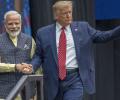
Pence, in response to a question from Chambers, who is also the USISPF chairman, said that he truly believes that the relationship between the US and India, because much of the work that the corporate sector have done, and the work of President Donald Trump and Prime Minister Narendra Modi, has never been stronger.

'With Trump, the relationship was very transactional, whereas with President Biden it is very structured.'

Dreams must be accompanied with a reality check on what they actually imply.

Asserting that there was growing scourge of terrorism in view of fast growing linkages of terrorist groups across the globe, India on Tuesday strongly advocated stepped up cooperation through intelligence exchange and training with 54 African countries.

'Significantly, Foreign Secretary Gokhale was received at very high level in Beijing.' 'It only shows China's keenness to move forward and put the relationship on a 'win-win' footing,' says Ambassador M K Bhadrakumar.
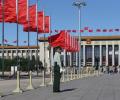
'Does the country risk being enclosed in a geographical cocoon if it spurns a multi-continent project for which everyone else has signed up,' asks T N Ninan.
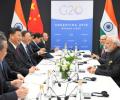
'The reason why we don't have an escalation of war like in 1962 is because in 1962, we didn't have this connectivity.' 'Whereas today, we have lots of incentives to stay stable and connected to China even though we still have that political rivalry.'

India and ASEAN have relations "free from contests and claims" and believe in sovereign equality of all nations irrespective of size, and support for free and open pathways of commerce and engagement, Prime Minister Narendra Modi wrote in his column.

It is the first meeting between the two leaders after India boycotted the high-profile Belt and Road Forum.

With Donald Trump unable to make it, Modi settles for Brazilian President Jair Bolsonaro.
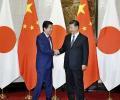
'Both Japan and China face a common challenge: How to deal with Trump.' 'The trade war with the US seems to have facilitated/hastened Abe's China visit, the first by a Japanese prime minister since 2011,' points out Dr Rajaram Panda.
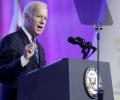
While inaugurating the leadership summit of the US-India Business Council in Washington, DC, US Vice President Joe Biden said that there was no reason why the two largest democracies in the world should not continue to have a more productive relationship. Aziz Haniffa/ Rediff.com reports.

In an oblique reference to China's Belt and Road Initiative, Prime Minister Narendra Modi on Friday cautioned against rolling out connectivity projects without respecting sovereignty and territorial integrity.
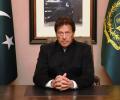
In his address to the nation on the Kashmir issue after India revoked the special status of Jammu and Kashmir on August 5, Khan assured the people of Pakistan that his government will stand by the Kashmiris till India lifts the restrictions in the Valley.
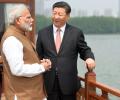
The BRI, a pet initiative of President Xi, is aimed at promoting network of roads, ports and rail networks all over the world to spread China's influence.

The new exchange will also help global companies raise finance from other overseas investors.

The India-Japan joint naval exercises are a strategic signal for China, observes Dr Rajaram Panda.
At a time when China is trying to make its foray into South Asia, India should use its shared history to strengthen its ties in the region, says Dr Rup Narayan Das.
